Date: 17. November 2026
Time to read: 1 min
The Slovenian language has reached another important milestone in its digital development. Spoken by just over two million people, the language now has its own large language model. Slovenia has thus joined a group of countries that are developing artificial intelligence in their own languages, thereby strengthening their technological sovereignty.
The generative model for Slovenian, known as GaMS, was developed by experts at the Centre for Language Resources and Technologies at the University of Ljubljana. Their aim was both to develop a large language model for Slovenian and to establish the core infrastructure for the development of artificial intelligence in Slovenian.
A step towards technological sovereignty
Although it is possible to interact in Slovenian with large language models such as ChatGPT, Claude and Gemini, these models are primarily trained on texts in English or other major world languages. As a result, they often perform less well in Slovenian and fail to recognise the language's distinctive features, cultural references and characteristics specific to Slovenia. GaMS, by contrast, was trained on approximately 25 billion words of Slovenian text, giving it a strong understanding of the language's distinctive features. Or, as lead developer Domen Vreš put it:
"It is no longer an American John trying to speak Slovenian, but rather our very own Slovenian Janez."
-
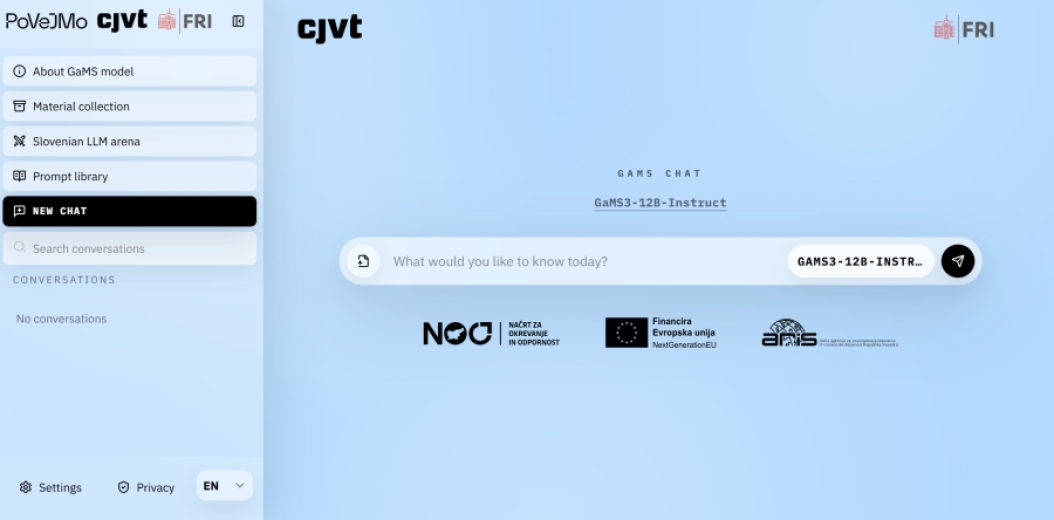 Large language models have transformed our daily lives, changing the ways we communicate, access information and function in the digital space. Photo: Print screen
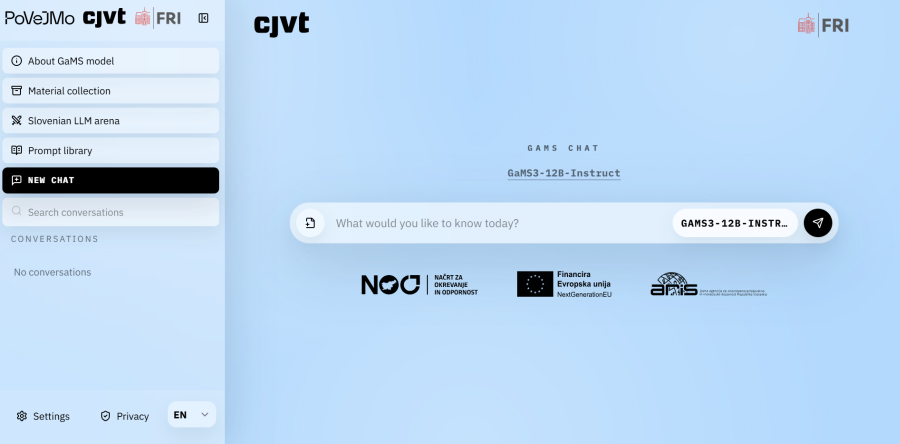
Developing a large language model for Slovenian required vast quantities of Slovenian-language text and computing power, so the European Leonardo supercomputer in Bologna was used alongside Slovenia's Vega supercomputer. "GaMS ranks among the most successful open-access large language models in its size class," explains Marko Robnik Šikonja, head of model development.
The researchers plan to add new capabilities to the model, enabling it to perform tasks more independently, and to continue training it as part of the Slovenian AI Factory project. They also stress that access to high-quality Slovenian texts and striking an appropriate balance between copyright protection and the development of artificial intelligence will be crucial for further development.
-
 Large language models are a type of artificial intelligence that learns language from vast datasets containing massive amounts of text, such as websites, books, articles and other written materials. Photo: ole CNX/Getty Images

Applications in medicine, industry, the humanities and computer science
GaMS is intended for use in research, education, business and the public sector.
Several Slovenian companies have already tested the model as part of the project. Using GaMS, Better developed an advanced medical application that supports electronic prescribing of medicines, automatic speech-to-text transcription for discharge summaries and the digitisation of forms by recognising text fields and entries.
Semantika adapted the model to automatically create multilingual presentation materials and power advanced interactive museum application for museums. Špica, meanwhile, developed an advanced industrial application that uses artificial intelligence to automate and streamline workflows in manufacturing, warehouses and supply chains. At XLAB, GaMS was used to develop an advanced application that improves data processing efficiency and, above all, the accuracy and robustness of generated source code and documentation.
-
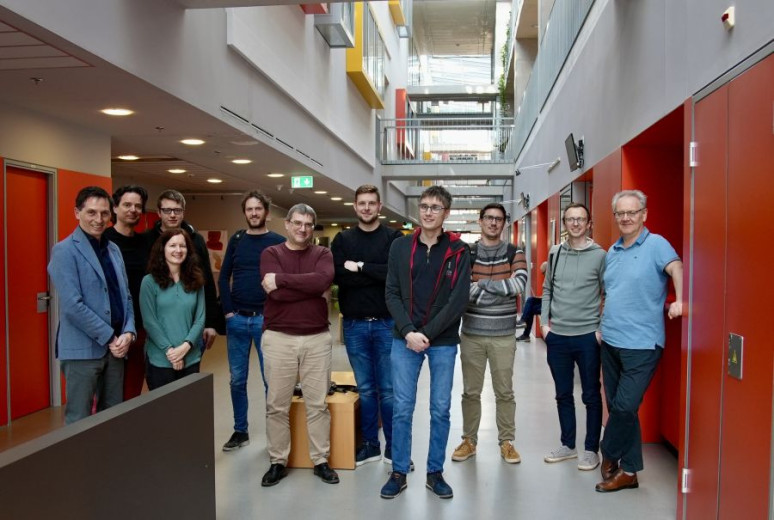 In order for Slovenian to retain its place in the digital future, Slovenian experts from the Centre for Language Resources and Technologies at the University of Ljubljana built a generative model for the Slovenian language – GaMS. Photo: PoVeJMo

All versions of GaMS, the large generative language model for Slovenian, are openly available and can be installed locally and tailored to users' various needs. GaMS thus contributes to the safer use of artificial intelligence, greater protection of the Slovenian language in the digital sphere and greater competitiveness for the Slovenian economy.
Cover photo: Tippapatt/Getty Images