Date: 10. January 2026
Time to read: 1 min
Idrija Miners Band dates back to 1665 wich ranks it among the oldest musical organisations in Slovenia and abroad. The first written reference to Idrija's musicians appears in the writings of Janez Vajkard Valvasor, in the 8th book of The Glory of the Duchy of Carniola (1689). Although the band was for most of its history closely connected to the Idrija Mercury Mine, its work was never limited solely to Idrija.
By the 19th century, the band’s reputation had already reached far beyond the hills surrounding Idrija. Idrija musicians performed in Postojna Cave on 11 March 1857, when Austrian Emperor Franz Joseph and Empress Elisabeth visited the cave on their return journey from Italy.
The prestige the band gained by the mid-19th century brought invitations to perform outside the town, while prominent musical associations also began visiting Idrija.
The people of Idrija thus welcomed the visit of the male choir of the Ljubljana Philharmonic Society, which accepted the invitation and performed during the celebration of St. Acacius’s Day on 22 June 1863.
-
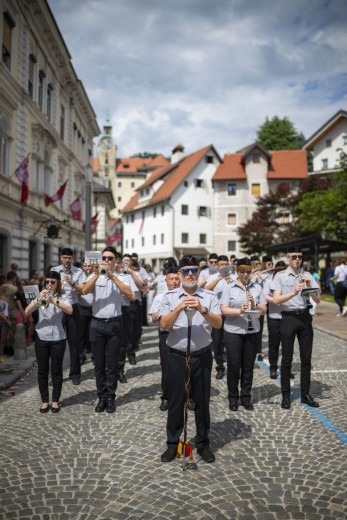 During the past years happened significant changes, transforming the band into a wind orchestra enriched with new instruments. Photo: Robert Zabukovec
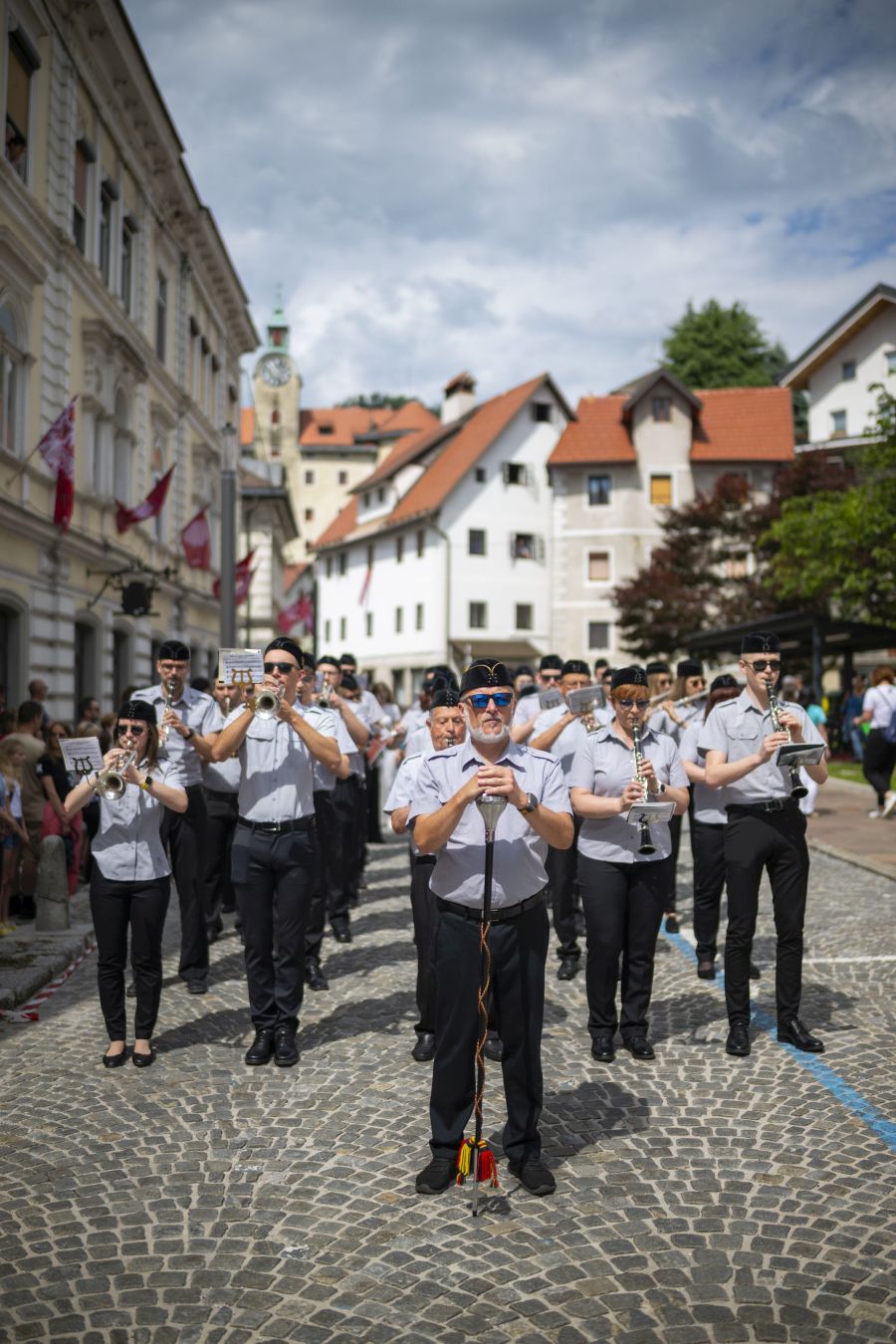
For a long time, major celebrations in Idrija were unimaginable without the band. This was also the case in 1880, when the feast of St. Acacius was marked by the celebration of the 300th anniversary of the final nationalization of the Mine. The celebration was attended by several representatives of state and provincial authorities. Toward the end of the 19th century, however, conditions for the band began to deteriorate.
In 1886, the band briefly disbanded, and more serious problems emerged in the early 20th century. In 1903, the miners’ band dissolved.
After the dissolution, members of the Social Democratic movement founded the Workers’ Brass Band Society “Naprej” (“Forward”) on 23 August 1903. Due to strained relations with mine management, the society operated under difficult conditions. The Mine refused to commission their performance for the procession on St. Acacius’s Day and also prohibited them from playing at the miners’ celebration held on the “Zemlja” site. Despite these obstacles, the society remained active until the First World War.
-
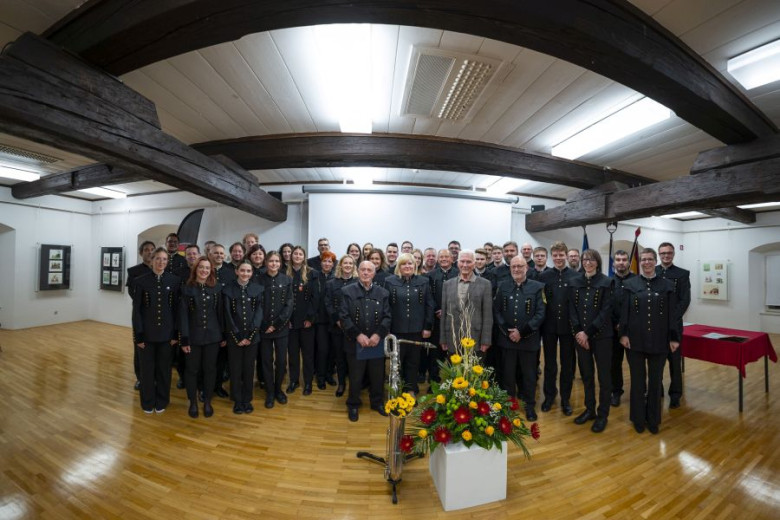 It has never been merely a festive accompaniment, it has been the heart of the Idrija and its voice in both good and difficult times. Photo: Robert Zabukovec
Disbandments and Bans
During the First World War, the society’s activities understandably came to a halt. In 1920, serious personal disputes arose, sparked directly by disagreements over participation in church ceremonies. When the society refused to take part in the Easter procession, several members resigned and formed the Catholic Brass Band Society within the Catholic Workers’ Association. The new society soon began performing publicly.
The original band continued to operate, though in a reduced form. In 1927, the fascist authorities abolished both societies.
Most musicians then joined the trade-union organization Dopolavoro, largely out of fear of unemployment. They performed at military parades, state and church holidays, and on excursions to nearby towns. Traditionally, they also gave concerts in the square in front of St. Barbara’s Church. Despite the Italian occupation, the band maintained a high level of quality.
At the beginning of the Second World War, the band was dissolved again, as musicians were conscripted into various branches of the Italian army and most instruments were seized by the Italian military (some have been preserved to this day).
During the war, several Idrija musicians joined the band of the IX Corps, performing at numerous rallies, while some sadly fell in battle.
The IX Corps Band performed in Idrija immediately after liberation, marking the beginning of a new and highly productive period for the Idrija band.
From the Post-War Period to the Present
After the war, musicians returned home and work resumed almost from nothing: there were neither instruments nor sheet music. Instruments were searched for in private homes and schools, and some were even found in Ljubljana. Composer and conductor Jože Klemenčič (1903 - 1964) gathered the musicians and instruments as early as 1945 and immediately began rehearsals. A youth band was also revived; it operated until 1951, when it merged with the older (trade-union) ensemble.
The musicians strongly supported the establishment of a music school, which reopened in 1946. Its first headmaster became Klemenčič, who led the school until his death.
In the mid-1970s, severe financial difficulties emerged. A decline in the global price of mercury caused partial suspension of mining, followed by a decision to gradually close the mine. This marked the end of the mine’s financial support for the band (1976). The financial crisis lasted more than 25 years; support from businesses, the local community, and residents mainly covered only the most urgent costs. In the late 1980s, the orchestra, exhausted by constant appeals for funding, ceased its activities for several months. Bandmaster Julijan Vidmar resigned in the autumn of 1990 and was succeeded by conductor Miroslav Matić (1991 - 1997).
An important turning point came with an agreement on financial cooperation between the Mine, the Municipality of Idrija, and the Idrija Miners’ Wind Orchestra in February 1995, but the arrangement collapsed by 1999.
In 1997, in accordance with new legislation governing associations, the orchestra was renamed the Idrija Miners’ Brass Band Society.
Later, the band successfully secured sponsorships from several companies, enabling faster development and its transformation into a symphonic wind ensemble.
-
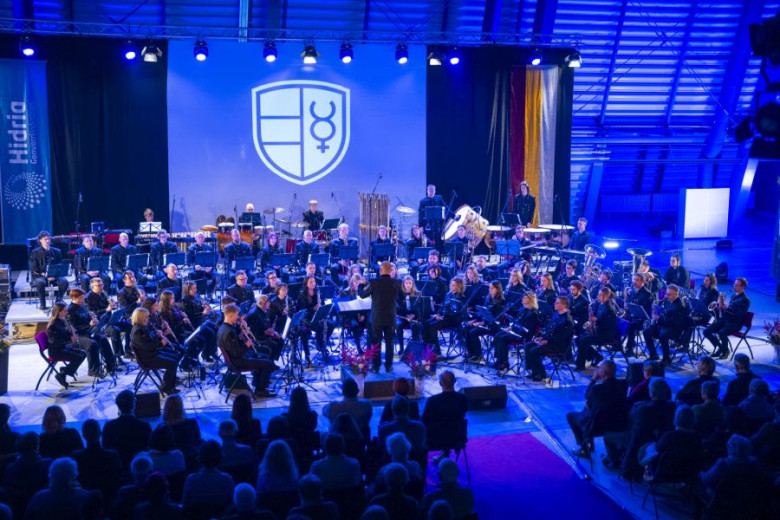 The ensemble made the Culture Ministry's list of intangible cultural heritage in 2013. The Idrija mercury mining heritage is meanwhile part of UNESCO's world heritage list. Photo: Robert Zabukovec

In 2013, the Idrija Miners’ Band Society was entered into the Register of Living Cultural Heritage at the Ministry of Culture of the Republic of Slovenia, which represents one of its most significant acknowledgements. Although its history is full of moments when the band stood on the verge of collapse, it never completely died out.
The Idrija Band is therefore more than a musical ensemble, it is the town’s sound record and a symbol of its perseverance.
It reflects a key characteristic of Slovenian brass bands: they are not merely accompaniment to celebrations, but guardians of community, discipline, and cultural memory, passed down from one generation to the next.